
Published: July 2026 | Author: Sam A V
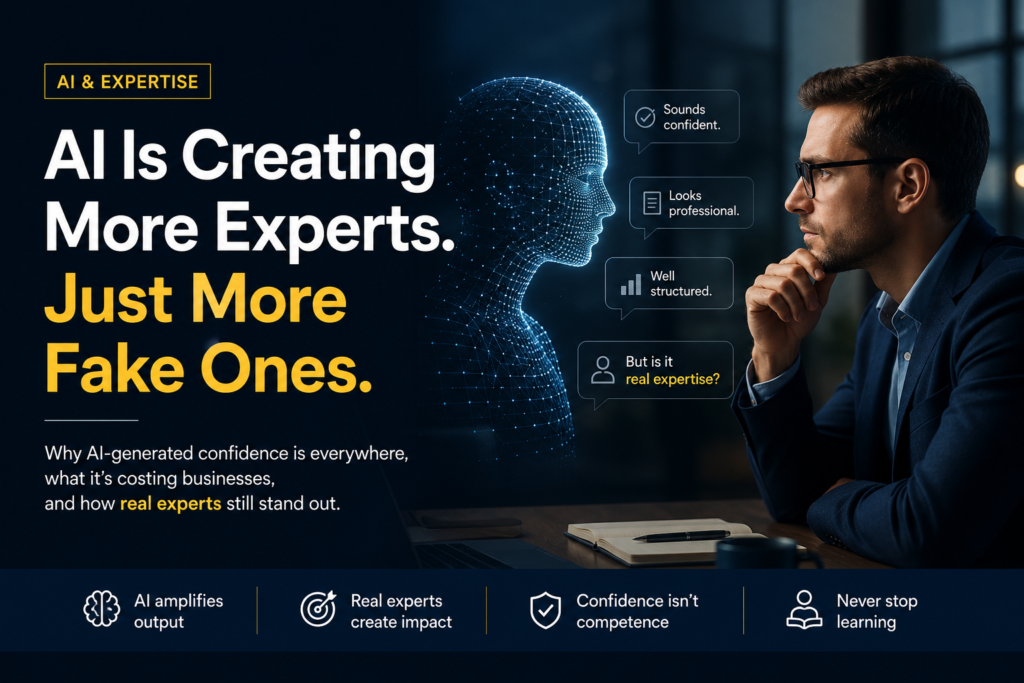
Artificial intelligence has transformed how we work, learn, and solve problems. Today, almost anyone can generate polished ideas, detailed plans, professional-looking content, or seemingly expert advice within minutes. While that's an incredible leap in productivity, it has also created a new challenge: it's becoming increasingly difficult to distinguish genuine expertise from AI-assisted confidence. The real question is no longer whether AI can produce impressive output, it's whether the person using it truly understands what they're creating. In the AI era, the professionals who stand out won't be those who simply generate answers, but those who know how to question, validate, and apply them to create real value.
How AI Changed What It Means to Be an Expert
This discussion builds on an idea I explored in my previous article,
Why Human Expertise Still Matters in the Age of AI. There, I explored why human judgment remains indispensable despite AI’s rapid advancement. In this article, we’ll build on that idea by looking at a new challenge: when AI can help almost anyone sound like an expert, how do we recognize genuine expertise anymore?
Not long ago, expertise was closely tied to access. If you wanted to understand a complex subject, you invested years in learning, experimenting, making mistakes, and gaining experience. Experts stood out because they possessed knowledge that wasn't easily available to everyone else. Whether you were building software, leading a business, designing products, practicing medicine, or managing finances, your expertise was earned through continuous learning and real-world problem-solving.
The internet was the first major shift. It made information available to anyone with a search engine, reducing the gap between experts and everyone else. But even then, finding an answer still required effort. You had to compare sources, filter conflicting opinions, understand context, and decide which information was actually reliable.
Artificial intelligence has changed the equation again. Instead of helping us find information, it helps us generate it. Today, anyone can ask AI to explain a complex concept, create a business plan, write code, analyze data, draft a proposal, or solve a technical problem within seconds. Tasks that once demanded hours of research can now be completed in minutes.
At first glance, it may seem as though AI has made everyone an expert. In reality, it has done something far more significant, it has changed what expertise actually means.
When knowledge is available to everyone, simply having access to information is no longer a competitive advantage. The professionals who stand out are no longer the ones who know the most facts, but the ones who know how to evaluate those facts. They question assumptions, recognize missing context, weigh trade-offs, adapt solutions to different situations, and understand the consequences of their decisions. In other words, expertise has shifted from knowing more to thinking better.
This shift has also created an interesting paradox. While AI has made high-quality outputs easier to produce, it has also made it much harder to distinguish genuine expertise from polished presentation. When almost everyone can generate convincing answers, impressive language is no longer proof of deep understanding.
That raises an important question: if AI can help almost anyone sound knowledgeable, why does it suddenly feel like everyone is an expert?
Why Everyone Suddenly Sounds Like an Expert
The answer isn't that millions of people have suddenly become experts overnight. It's that AI has dramatically lowered the barrier to expressing ideas in a way that feels authoritative.
For years, clear communication was often seen as a signal of expertise. If someone could explain a complex concept with confidence, write a well-structured article, present a convincing strategy, or answer questions fluently, we naturally assumed they understood the subject deeply. It was a reasonable assumption because producing that level of work usually required years of learning and experience.
AI has changed that assumption.
Today, someone with limited experience can produce content that looks remarkably similar to work created by seasoned professionals. Reports are better formatted, presentations are more persuasive, emails are more polished, and explanations are more coherent. The quality of expression has become easier to achieve, even when the quality of understanding hasn't changed.
This isn't a criticism of AI. In fact, it's one of AI's greatest strengths. It helps people communicate more clearly, organize their thoughts, and overcome the blank page faster than ever before. Used responsibly, that's a tremendous advantage for individuals and businesses alike.
The challenge begins when polished communication is mistaken for genuine expertise.
A business plan that reads well isn't automatically a viable business strategy. A detailed analysis isn't necessarily a correct one. A confident recommendation isn't always the best decision. In the same way, a beautifully written answer generated with AI can still overlook critical context, make incorrect assumptions, or fail when applied to a real-world situation.
That's why the AI era demands a subtle but important shift in how we evaluate expertise. Instead of asking, "Does this sound convincing?" we need to ask, "Is this accurate? Has it been validated? Will it actually work in practice?"
The professionals who earn lasting trust won't be the ones who produce the most impressive-looking outputs. They'll be the ones whose ideas continue to hold up when they're tested in the real world.
AI Doesn't Replace Expertise. It Reveals It.
One of the biggest misconceptions about AI is that it levels the playing field. Since everyone has access to the same tools, it's easy to assume that expertise has become less valuable. In reality, the opposite is happening. AI is exposing the difference between people who understand their craft and those who simply know how to generate an answer.
Consider two professionals asked to solve the same business problem using the same AI tool. Both receive similar suggestions, similar recommendations, and similar starting points. Yet the final outcome is rarely the same.
The experienced professional doesn't stop at the first response. They challenge assumptions, refine the prompts, verify the facts, consider constraints, and adapt the output to fit the real-world situation. They know where AI is likely to oversimplify a problem, where important context might be missing, and where human judgment is essential before making a decision.
Someone with less experience often approaches AI differently. They may accept the response at face value because it sounds logical and well-structured. The result might look impressive, but it can overlook practical realities, hidden risks, or exceptions that only become obvious through experience.
This difference becomes visible across every profession. An experienced developer doesn't just ask AI to write code, they review its architecture, evaluate security implications, and ensure it aligns with the broader system. A product manager doesn't accept every AI-generated feature idea, they validate it against customer needs, business goals, and technical feasibility. A marketer doesn't publish every AI-generated campaign, they refine the messaging based on audience insights, brand positioning, and market context. The same pattern applies whether you're running a business, managing operations, analyzing data, or leading a team.
This is why AI should be viewed as a collaborator rather than an authority. It can accelerate research, generate ideas, identify patterns, and reduce repetitive work, but it cannot take responsibility for the decisions that follow. Responsibility still belongs to the person using it.
In many ways, AI acts like a mirror. It reflects the quality of the person working with it. Someone with deep expertise uses AI to explore better possibilities, uncover blind spots, and move faster without compromising quality. Someone without that foundation may produce work that appears equally polished but lacks the depth needed to withstand real-world challenges.
Ultimately, AI doesn't replace expertise, it amplifies it. The stronger your understanding, the more value you can extract from AI. The weaker your understanding, the easier it becomes to mistake convincing outputs for correct ones. And in a world where important decisions increasingly involve AI, that distinction matters more than ever.
The Hidden Cost of AI-Generated Confidence
When AI first entered the workplace, most conversations revolved around one question: How much faster can we get things done? It's an important question, but it overlooks another one that may have a much bigger impact in the long run:
What happens when organizations begin rewarding confidence more than competence?
This isn't a future problem, it's already happening.
Imagine interviewing two candidates. Both use AI. Both submit polished assignments. Both speak confidently about industry trends and best practices. On paper, they appear equally capable. But once they're faced with an unfamiliar problem, one without a ready-made answer, the difference quickly becomes apparent. One can reason through uncertainty, adapt to changing circumstances, and make sound decisions. The other struggles because they've learned to rely on AI for answers rather than developing the thinking process behind them.
Now multiply that across an entire organization.
Over time, businesses risk creating teams that are highly efficient at producing outputs but less capable of solving complex problems. Meetings become filled with ideas that sound impressive but aren't challenged. Decisions are made more quickly, yet not necessarily more wisely. Everyone has access to similar AI tools, so the work begins to look increasingly alike, making genuine innovation harder to achieve.
There's another cost that's easy to overlook: the erosion of institutional knowledge. When employees depend on AI to answer every question instead of understanding the systems, customers, and industry they work in, valuable expertise stops accumulating inside the organization. Experienced professionals retire or move on, but the knowledge they've built through years of solving real problems isn't easily replaced by an AI-generated summary.
Ironically, the greatest risk isn't that AI will replace experts. It's that organizations may stop investing in creating them.
The companies that succeed over the next decade won't simply be the ones that adopt AI the fastest. They'll be the ones that continue to develop curious thinkers, encourage healthy debate, reward sound judgment, and treat AI as a powerful assistant, not a substitute for experience. Because while AI can accelerate today's work, it's people who build tomorrow's expertise.
Productivity Is Easy. Creating Value Is Hard.
One of AI's greatest strengths is its ability to remove friction. Tasks that once took hours can now be completed in minutes. Research becomes faster, brainstorming becomes easier, and the time between an idea and its execution has never been shorter. For businesses, that translates into higher productivity, lower operational costs, and the ability to move at a pace that was difficult to imagine just a few years ago.
But productivity, by itself, has never been the goal.
A team can publish more content than ever before and still fail to attract customers. A company can build features faster and still solve the wrong problems. A business can automate customer interactions and still leave customers frustrated. Producing more work doesn't automatically create more value.
That's because value isn't measured by the volume of output, it's measured by the impact that output creates.
The companies gaining the most from AI understand this distinction. They don't use AI simply because it helps them work faster. They use it to free up time for the work that matters most: understanding customers, making better decisions, improving products, solving complex problems, and exploring ideas that require creativity and strategic thinking. In other words, they allow AI to handle repetitive tasks so people can focus on work that demands human insight.
This is where many organizations unintentionally fall into a trap. They begin measuring success by efficiency alone, how many reports were generated, how many campaigns were launched, how many features were shipped, or how quickly projects were completed. Those metrics may look impressive on a dashboard, but they reveal very little about whether customers are happier, products are better, or the business is stronger.
The real competitive advantage isn't using AI to do more work. It's using AI to create better work.
The organizations that will lead in the years ahead won't be those producing the highest volume of AI-generated output. They'll be the ones that consistently turn AI-assisted productivity into meaningful outcomes, for their customers, their employees, and their business. Because in the end, people rarely remember how quickly something was created. They remember whether it solved their problem.
Key Takeaways
Artificial intelligence hasn't made expertise obsolete, it has changed how we recognize it. Today, almost anyone can produce polished work, but polished work alone is no longer proof of deep understanding. As AI becomes more capable, the ability to think critically, ask better questions, apply context, and make sound decisions becomes even more valuable.
Perhaps that's the biggest lesson of the AI era: AI doesn't replace expertise; it amplifies it. When it's placed in the hands of an experienced professional, it accelerates productivity and unlocks new possibilities. When it's used without sufficient understanding, it can amplify assumptions, overconfidence, and poor decisions just as quickly.
So, how do you recognize real expertise in a world where everyone has access to the same AI tools? Look beyond polished presentations and confident answers. Real experts are curious enough to ask questions before offering solutions. They acknowledge uncertainty when the situation demands it. They explain trade-offs instead of presenting one-size-fits-all answers. Most importantly, they adapt their thinking as new information becomes available rather than relying on the first response they receive.
The same principle applies to organizations. The businesses that will thrive won't necessarily be the ones with the most advanced AI tools, they'll be the ones that build teams capable of thinking independently, challenging assumptions, and combining AI with strong domain knowledge. Technology can improve efficiency, but people create innovation, trust, and lasting value.
Finally, don't think of AI as a shortcut to expertise. Think of it as a partner in the learning process. Use it to explore unfamiliar topics, challenge your own ideas, and accelerate your growth, but never stop building the experience and judgment that no tool can provide on its own. The professionals who will stand out in the years ahead won't simply be the best at using AI. They'll be the ones who continue learning long after everyone else has settled for generating answers.
Frequently Asked Questions
If AI can do so much, is becoming an expert still worth the effort?
Absolutely. AI has made knowledge more accessible, but it hasn't replaced the experience, judgment, and decision-making that come from solving real-world problems. In fact, as AI becomes more widely available, genuine expertise becomes easier to recognize and even more valuable.
How can I tell whether I'm genuinely learning or just becoming dependent on AI?
A simple test is to ask yourself whether you can explain the reasoning behind an AI-generated answer, adapt it to a different situation, or solve a similar problem without relying on AI. If the answer is no, AI may be helping you complete tasks, but it isn't yet helping you build expertise.
Does using AI make me less skilled over time?
Not necessarily. It depends on how you use it. If AI replaces your thinking, your growth may slow down. If it challenges your thinking, helps you explore new ideas, and accelerates your learning, it can make you a stronger professional over time.
Will companies value AI skills more than domain expertise?
The most successful organizations are looking for both. Knowing how to use AI is becoming an important skill, but AI tools change rapidly. Domain expertise, critical thinking, and the ability to solve real business problems remain the qualities that create long-term value.
If everyone has access to the same AI tools, what will set professionals apart?
Not the prompts they write, but the decisions they make. The professionals who stand out will be those who ask better questions, evaluate AI outputs critically, understand context, and consistently turn information into meaningful outcomes.
What's the best way to use AI without losing my ability to think independently?
Treat AI as a collaborator, not a decision-maker. Use it to brainstorm, learn, and accelerate routine work, but continue questioning its outputs, validating important information, and making the final decisions yourself. AI should strengthen your thinking, not replace it.