
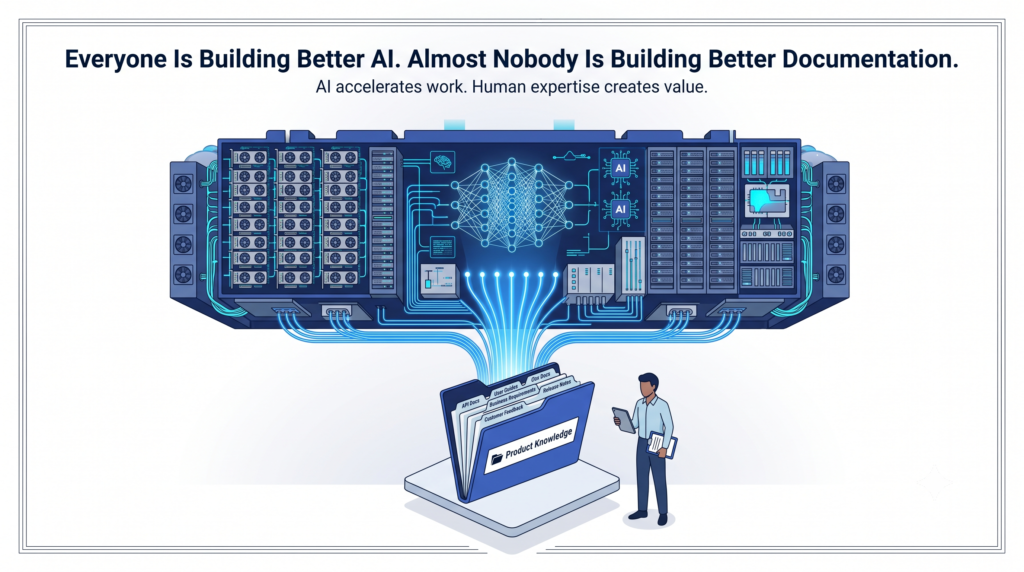
AI accelerates work. Human expertise creates value.
Everyone Is Asking the Wrong Question
Artificial Intelligence has become the centerpiece of almost every business conversation. Whether it's content creation, software development, customer support, or marketing, AI is being positioned as the technology that will redefine how organizations operate. Every major product launch is accompanied by headlines predicting the end of traditional jobs, while social media is flooded with debates about whether AI will eventually replace human expertise.
It's an understandable reaction. AI can produce results at a speed that would have been unimaginable just a few years ago. A blog draft can be generated in minutes, meeting notes can be summarized instantly, and thousands of customer queries can be answered simultaneously. For organizations under constant pressure to reduce costs and improve efficiency, the promise of AI is difficult to ignore.
However, something interesting has happened over the last couple of years. As businesses have moved beyond experimentation and started integrating AI into their daily operations, the conversation has begun to change. Instead of asking whether AI can replace people, many leaders are now asking a far more practical question: Where does AI genuinely add value, and where does human expertise remain essential?
That shift in thinking is significant because it reflects what companies are experiencing in the real world. AI has proven to be an exceptional productivity tool, but it has also exposed a misconception that many organizations had from the beginning. The expectation was never simply to automate repetitive work. Many believed AI could understand business objectives, make informed decisions, and produce reliable outcomes with little human involvement. Reality has shown otherwise.
The issue isn't that AI has failed. In fact, modern AI systems are remarkably capable. The real problem is that businesses often expect AI to solve challenges that have little to do with artificial intelligence. Poor documentation, inconsistent business processes, outdated knowledge bases, and unclear requirements don't disappear simply because AI is introduced. If anything, AI amplifies these problems by generating outputs based on the information it receives.
This is why I believe the discussion around AI needs to change. The future isn't about choosing between humans and AI. It's about understanding the strengths of each and designing workflows where both contribute their best. Organizations that recognize this are already seeing better results than those pursuing automation for its own sake.
AI Doesn't Fail. Our Expectations Do.
One of the biggest misconceptions about AI is that it "thinks" like an experienced professional. In reality, AI doesn't reason, question assumptions, or understand business objectives. It identifies patterns from the information it has been trained on and generates the most probable response based on those patterns. That distinction may sound technical, but it explains why AI can be incredibly useful in some situations and surprisingly unreliable in others.
Imagine asking AI to create user documentation for a newly released software feature. If the product requirements are complete, the engineering team has updated the API specifications, and the existing documentation is accurate, AI can produce an impressive first draft within minutes. It can organize information logically, improve readability, and save hours of manual effort.
Now change one thing.
The product requirements haven't been updated. The API documentation is six months old, the support team uses different terminology than engineering, and there are three versions of the same procedure scattered across different repositories.
AI will still produce a document.
It may even look polished.
The problem is that it has no way of knowing which information reflects reality.
This is where many businesses misunderstand AI. When the output is inaccurate, the immediate reaction is often to blame the model. The assumption is that upgrading to a newer version or providing more data will solve the problem. More often than not, the issue has nothing to do with the AI itself. It stems from the quality of the information available to it.
In many ways, AI behaves like a highly efficient employee joining your organization on the first day. Give that employee clear documentation, consistent processes, and reliable information, and they'll become productive quickly. Give them outdated procedures, conflicting instructions, and incomplete requirements, and they'll make mistakes despite their best efforts. The same principle applies to AI.
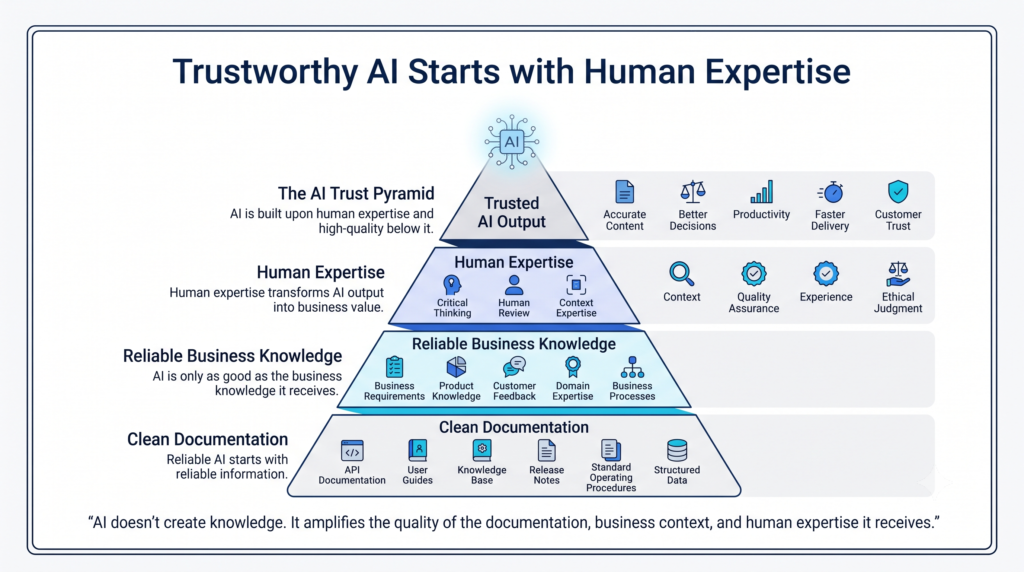
This is particularly relevant for technical documentation. As organizations adopt AI to improve productivity, the quality of their documentation becomes more important than ever. Well-structured user guides, API references, release notes, and knowledge bases don't just help customers. They provide AI with the reliable context it needs to generate accurate and consistent outputs. Good documentation is no longer just a business asset. It is becoming the foundation of successful AI adoption.
Why More Data Isn't Always Better
A common assumption in AI projects is that more information automatically leads to better results. It sounds logical. If AI learns from data, then giving it more data should make it smarter.
Unfortunately, business environments are rarely that simple.
Most organizations have accumulated years of documentation, emails, spreadsheets, meeting notes, product specifications, and support articles. While this information is valuable, it isn't always accurate, current, or consistent. Feeding all of it into an AI system doesn't necessarily improve its responses. In many cases, it introduces more confusion.
Think of it like asking someone to assemble a piece of furniture using three different instruction manuals, each describing a slightly different version of the same product. More information doesn't make the task easier if the information conflicts with itself.
AI doesn’t create bad information. It amplifies the quality of the information it receives.
The same challenge exists in AI.
Businesses often invest heavily in advanced AI models while overlooking a more fundamental question: Can we trust the information we're asking AI to work with?
The organizations seeing the greatest success with AI are not always those with the largest knowledge bases. They are the ones with the cleanest, most structured, and well-maintained information. This is why documentation teams, knowledge managers, and technical writers have become increasingly important in the AI era. Their work doesn't just support users anymore. It directly influences the quality of AI-generated outputs.
Human Review Is Still the Best Quality Control
One of the first lessons businesses learn after deploying AI at scale is that speed should never come at the expense of accuracy.
AI can generate content faster than any human, but it cannot take responsibility for the information it produces. It doesn't know whether a recommendation violates company policy, whether a configuration step could cause a system failure, or whether a customer-facing document reflects the latest product update. It simply generates what appears to be the most likely answer.
This is why human review should never be viewed as an optional final step. It is a critical part of the process.
An experienced technical writer doesn't simply correct grammar or improve formatting. They validate technical accuracy, question inconsistencies, identify missing information, and ensure the documentation reflects the real product. A product manager reviews whether the content aligns with business objectives. A customer support specialist understands the questions customers actually ask, not just the ones documented in an internal knowledge base.
These are responsibilities that require experience, judgment, and context. They cannot be automated simply by using a more advanced AI model.
Perhaps the biggest mistake organizations can make is assuming AI eliminates the need for expertise. In reality, AI makes expertise even more valuable. The faster AI generates information, the more important it becomes to have professionals who can verify that information, interpret it correctly, and decide whether it should be trusted.
The companies gaining the most from AI are not replacing experts. They are allowing experts to spend less time on repetitive work and more time applying the skills that machines still cannot replicate: critical thinking, business judgment, and informed decision-making.
The Real Cost of AI Is More Complicated Than a Monthly Subscription
One of the biggest selling points of AI has always been cost reduction. Businesses are told that AI can write content faster, answer customer queries instantly, automate repetitive tasks, and reduce operational expenses. On the surface, the economics appear straightforward. A monthly AI subscription costs far less than hiring additional employees, so replacing manual work with AI should automatically reduce costs.
The reality is more nuanced.
The true cost of AI isn't determined by the price of the software. It's determined by the total cost of building, operating, validating, and maintaining AI-powered workflows.
At the enterprise level, this becomes even more apparent. Recent industry estimates suggest that the world's largest technology companies are investing close to $750 billion in AI infrastructure, including data centers, GPUs, networking equipment, and power systems. Yet the direct annual revenue generated from AI services remains only a fraction of that investment. While infrastructure-led investment cycles are not unusual in technology, the gap highlights an important reality: the AI industry is still in its growth phase, and long-term profitability depends on widespread business adoption.
This raises an interesting question for business leaders.
If AI infrastructure continues to become more expensive, will enterprises continue increasing their AI spending at the same pace?
No one knows the answer yet.
Unlike the Dot-com era, today's AI investments are largely being funded by some of the world's most profitable technology companies rather than speculative startups. That makes a complete market collapse far less likely. However, it doesn't mean every AI investment will deliver the expected return.
Businesses are becoming increasingly selective. Instead of adopting AI because it's the latest trend, they're asking a much healthier question:
"Does this AI solution create measurable business value?"
That shift is already changing how organizations invest in AI.
Companies are moving away from experimenting with AI in every department and focusing instead on workflows where the return on investment is clear. Customer support automation, software development, technical documentation, code review, and knowledge management continue to show strong business value because they combine AI's speed with human expertise.
Projects driven purely by hype are finding it much harder to justify their costs.
The discussion becomes even more relevant when we look beyond infrastructure spending and examine how organizations actually use AI internally.
Generating content is inexpensive.
Trusting that content is not.
Every AI-generated proposal, technical document, customer response, or marketing campaign still requires someone to review it. Someone must verify technical accuracy, ensure regulatory compliance, validate business assumptions, and confirm that the final output reflects the organization's objectives.
That hidden work is rarely included when businesses calculate the return on investment of AI.
Imagine a technical writer using AI to generate an installation guide for enterprise software. The first draft may take only five minutes to produce, but publishing inaccurate deployment steps could lead to failed implementations, increased support tickets, engineering rework, and frustrated customers. The time saved during content creation can quickly be lost resolving problems that should never have reached production.
This is why the conversation around AI costs needs to evolve. The goal shouldn't be replacing experienced professionals with AI simply because software appears cheaper. The goal should be enabling those professionals to work faster while maintaining the quality, accuracy, and trust that businesses depend on.
In many ways, AI is following the same path as cloud computing did a decade ago. The companies that benefited most weren't the ones that adopted cloud services first. They were the ones that understood where cloud technology created genuine business value.
AI will be no different.
Organizations that treat AI as a productivity multiplier rather than a replacement strategy are far more likely to see sustainable returns over the long term.
“The companies that eventually win the AI race may not be the ones building the biggest models. They may be the ones building the clearest knowledge bases.”
Final Thoughts
The conversation around AI has become increasingly polarized. On one side are those who believe AI will replace most professional jobs. On the other are those who dismiss it as just another technology trend. In reality, both perspectives miss an important point.
AI is neither a magical solution that can solve every business problem nor a passing trend that organizations can afford to ignore. It is one of the most powerful productivity tools ever created, but like every tool before it, its value depends entirely on how people choose to use it.
Throughout this article, we've explored a recurring theme. AI excels at generating information, identifying patterns, and accelerating repetitive work. What it cannot do is understand why a business exists, what customers truly value, or which decision best supports an organization's long-term goals. Those decisions require context, experience, critical thinking, and accountability, all of which remain uniquely human strengths.
Perhaps the biggest lesson businesses are learning today is that successful AI adoption has very little to do with buying the latest model. Instead, it depends on building strong foundations. Clear business objectives, well-structured documentation, reliable knowledge management, and experienced professionals have become just as important as the AI itself. Organizations that overlook these fundamentals often discover that AI doesn't solve their problems; it simply exposes them faster.
This is particularly true for technical documentation and business communication. As AI becomes deeply integrated into products and workflows, the quality of the information it receives will directly influence the quality of the information it produces. Clean documentation, consistent terminology, and accurate knowledge bases are no longer operational assets. They are becoming strategic assets that determine how effectively AI can support a business.
Looking ahead, I don't believe the winners of the AI era will be the companies that automate the most tasks or invest the most money in AI infrastructure. They will be the organizations that understand where automation creates value and where human expertise remains indispensable. They'll use AI to remove repetitive work, allowing their people to focus on solving complex problems, making informed decisions, and creating better experiences for customers.
The future has never been about AI versus humans. It has always been about AI with humans.
Technology can generate content, analyze data, and automate workflows. But purpose, judgment, creativity, empathy, and business strategy still begin with people.
That is why human expertise still matters in AI today, and why it will continue to matter long after today's AI models are replaced by the next generation.
Frequently Asked Questions
1. Why does human expertise still matter in AI?
AI is excellent at processing information and generating content, but it lacks business context, critical thinking, empathy, and strategic judgment. Human expertise ensures AI-generated outputs are accurate, relevant, and aligned with organizational goals.
2. Will AI replace humans completely?
No. AI will continue to automate repetitive and structured tasks, but professions requiring creativity, decision-making, communication, and domain expertise will continue to depend on people. The future is more likely to involve collaboration between AI and human professionals.
3. Why is human oversight important in AI?
Human oversight helps identify hallucinations, verify technical accuracy, ensure regulatory compliance, and maintain quality standards. It reduces the risks associated with relying solely on AI-generated information.
4. How can businesses use AI effectively?
Businesses should use AI to automate repetitive work, accelerate content creation, and improve productivity while keeping humans responsible for reviewing outputs, making strategic decisions, and maintaining high-quality documentation and knowledge.